Building a Company
AI Strategy
A Comprehensive Framework
From Governance to Implementation
Table of Contents
Introduction & AI Strategy Overview >
Foundation principles and business value drivers for AI adoption
AI Governance Frameworks >
Establishing policies, controls, and organizational structures
Ethics & Responsible AI >
Ensuring fairness, transparency, accountability, and trust
AI Committee Structure >
Cross-functional leadership and decision-making framework
Organizational Enablement >
Building capabilities, skills, and infrastructure
Change Management Approach >
Addressing cultural and operational transformation
Framework on How to Approach AI >
Phased approach with clear milestones and dependencies
Key Takeaways >
Critical success factors and action steps
What is an AI Strategy?
A comprehensive plan that integrates artificial intelligence capabilities into your organization's operations, decision-making, and growth initiatives.
Strategic Vision
Aligns AI initiatives with business goals
Roadmap for Success
Guides implementation priorities and resource allocation
Key Components
- Strategic business objectives
- Governance & ethical framework
- Technology infrastructure
- Implementation roadmap
- Talent & organizational structure
- Change management plan
Business Value Drivers
Revenue Growth
New products, services, and enhanced customer experiences
Cost Reduction
Automation, optimization, and operational efficiencyInnovation Acceleration
Faster R&D, product development, and market entryDecision Intelligence
Enhanced data-driven insights and forecastingFoundation Principles

Human Centered
Ethical & Responsible
Secure & Compliant

Integrated

Adaptive

Scalable
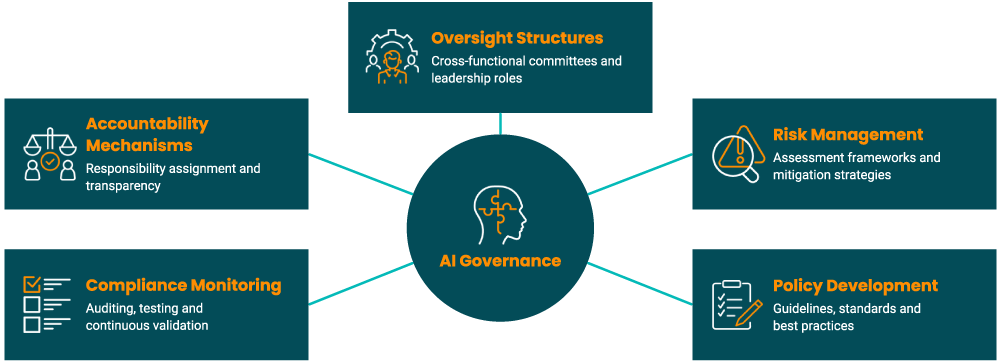
Why Governance Matters
- Ensures Ethical AI Development
Guides responsible creation and use of AI systems - Regulatory Compliance
Addresses evolving AI regulations and standards - Builds Trust
Establishes confidence with customers and stakeholders
Implementation Best Practices
- Integrated Framework
Connect components for comprehensive oversight - Iterative Approach
Continuously refine policies as AI technology evolves - Cross-functional Collaboration
Involve stakeholders from all relevant departments

Transparency
Clear, explainable AI decisions and operations
Fairness
Equitable, unbiased treatment across groups
Privacy
Protection of sensitive data and groups
Accountability
Clear ownership and responsibility for outcomes
Human Oversight
Maintaining human control and review capability
Operationalizing Ethical AI
Bias Testing
- Regular data audits
- Diverse test sets
- Outcome monitoring
Explainable AI
- Decision rationales
- Transparent algorithms
- User-friendly interfaces
Privacy by Design
- Data minimization
- Encryption protocols
- Consent management
Ethical Reviews
- Regular assessments
- Diverse review panels
- Stakeholder feedback

Ethics is not a constraint but an enabler of sustainable AI adoption andvalue creation. Organizations that prioritize ethical AI build strongertrust with customers, employees, and stakeholders.

Key Roles & Responsibilities
Executive Sponsor
Strategic direction
Resource Allocation
Board reporting
Data/AI Experts
Technical oversight
Risk assessment
Innovation guidance
Legal/Compliance
Regulatory compliance
Policy development
Risk management
Business Leaders
Use case prioritization
Value assessment
Implementation/feedback
Ethics Specialists
Ethical reviews
Bias detection
Social impact assessment
Security/Privacy
Data protection
Security standards
Privacy assessments
Committee Operations
-
Cadence
Monthly core meetings -
Reporting
Quarterly to Executive Team -
Agenda
Project reviews, policy updates, risks
Committee Effectiveness
-
Diverse Representation
Includes members from different departments, backgrounds, and levels -
Clear Success Metrics
Define KPIs to measure committee effectiveness and impact
Skills & Talent Development
- Training Programs – AI literacy curriculum for all employees, specialized technical training, learning pathways
- Hiring Strategy – Talent acquisition plan, role definitions, competitive compensation, retention incentives
- Cross-functional Skill Building – Collaborative learning, job rotations, communities of practice, mentorship programs
Technology & Infrastructure
- Scalable & future-ready – Integrated data lakes, quality assurance systems, metadata management, governance tools
- Computing Resources– Cloud infrastructure, GPU/TPU capacity, scalable environments, processing optimization
- Tools & Platforms – Model development environments, integration frameworks, monitoring solutions, security tools
Operating Model
- Roles & Responsibilities – Clear ownership, RACI matrices, decision rights, specialized AI roles integrated with business
- Workflows & Processes – Model lifecycle management, cross-functional collaboration, approval workflows, feedback loops
. - Governance Integration– Policy enforcement mechanisms, ethics reviews, risk assessments, compliance checks
Knowledge Management
- Documentation – Code repositories, model cards, data dictionaries, architecture diagrams, use case inventories
- Sharing Best Practices– Internal communities, case studies, success stories, lessons learned, reusable components
- Continuous Learning– Innovation labs, R&D programs, external partnerships, technology scouting, experimentation
Successful AI integration requires systematic development across all enablement dimensions. Organizations should start with foundational capabilitiesand progressively build more sophisticated elements as their AI maturity increases.

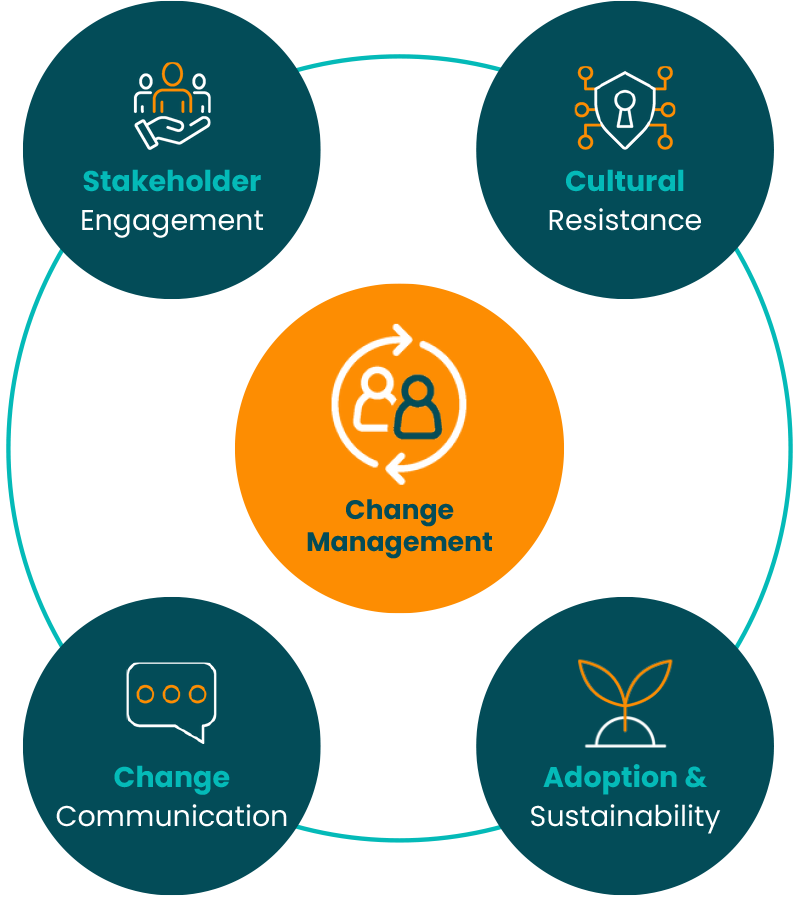
Successful AI adoption requires systematic change management that addresses both rational and emotional responses to new technologies. The most effective approaches integrate all component sin a continuous cycle.
Stakeholder Engagement
Identify key groups by influence and impact
Customize approaches by stakeholder needs

Create an "AI Impact Assessment" for each department
Cultural Resistance
Demystify AI technology and capabilities
Job security, skills relevance, control loss
Host "AI Myth-busting" sessions with demonstrations
Change Communication
Town halls, newsletters, training sessions
Surveys, listening sessions, anonymous inputs
Create and "AI Transformation Journey Map"
Adoptability & Sustainability
Peer advocates, early adopters, success stoires
Celebrate wins, share successes, reward adoption
Implement "AI Skill Badges" to incentive learning
Strategic Alignment
AI initiatives must directly connect to core business objectives and deliver measurable value

Governance & Ethics First

Cross-functional Teams
Diverse perspectives and clear decision rights accelerate innovation and adoption

Proactive Change Management
Address the human aspects of AI transformation from the planning stages forward

Measure What Matters
Define clear success metrics for each phase to prove value and guide decision-making

Incremental Implementation
Start with high-value, lower-risk use cases and scale progressively based on results
Getting Started: Next Steps
Assessment
Conduct AI readiness assessment and data inventory
Form Committee
Establish cross-functional AI governance team
Draft Strategy
Create initial strategy document with clear vision
Pilot Selection
Identify 2-3 high-impact initial use cases
Education
Begin AI literacy program for key stakeholders
Roadmap
Create detailed 90-day implementation plan
"The most successful AI transformations begin with clear strategy and thoughtful governance, not just technology implementation."
Industry-recognized and certified to support your IT needs
Trusted by 1,700+ mid-size and enterprise companies, we operate as an extension of your team—solving problems with urgency and accountability so you can focus on strategy, not firefighting. We are not just another MSP. We're your force multiplier that bring proven frameworks and real-world experience to help you secure, scale and streamline operations with fewer resources. Stop juggling vendors. Stop fighting uphill battles. Work with an IT partner who gets IT.